Most brands treat social media marketing like a numbers game: post, boost, wait, and hope something sticks while reach quietly shrinks every quarter and the same excuses get recycled.
Here's the part nobody says out loud in the marketing meeting: even a follower who likes your page probably never sees your next post, and that isn't a creativity problem, it's simple math working against you.
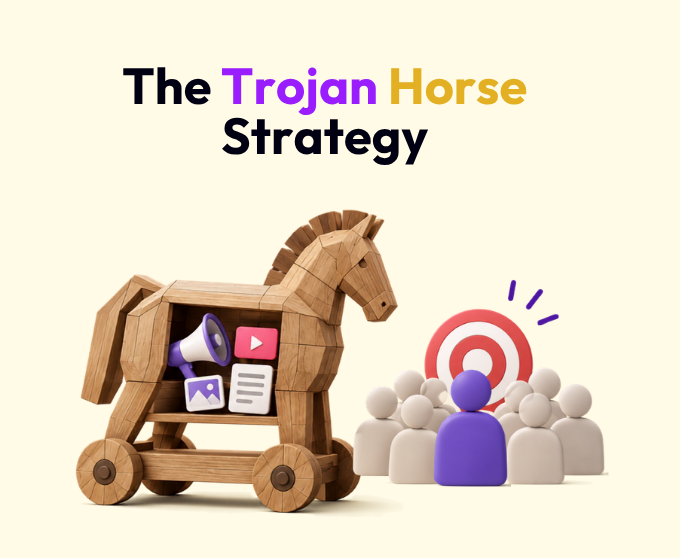
So let's talk about a smarter marketing strategy, one built around a very old idea: the Trojan Horse Strategy.
What Is the Trojan Horse Strategy?
The Trojan Horse Strategy is a marketing approach where your brand message travels inside content people already want, rather than arriving as an ad they've learned to scroll past. You lead with something genuinely valuable, a laugh, a useful answer, an honest story, and let the brand ride along quietly inside it.
There's no wooden horse or siege involved, just a good idea with your brand's fingerprints on it.
Take a skincare brand that skips "Buy our serum now" in favor of "5 things your dermatologist wishes you knew," letting the serum show up as the answer buried in point three. The reader doesn't feel sold to, they walk away having learned something, and the brand still gets its message across.
The Reality Brands Still Don't Want to Admit
Organic reach has genuinely collapsed. In 2025, the average Facebook post reached between 1% and 2% of a page's followers, while Instagram's organic reach dropped roughly 12% year over year and LinkedIn fell even further, according to Hootsuite's organic reach research. Do the math on a page with 10,000 followers, and that range works out to somewhere between 100 and 200 people actually seeing a given post.
People are also opting out of advertising altogether. Just over half of consumers across 48 global markets have installed or used an ad blocker on their browser or phone, according to eMarketer's research on ad blocking behaviour. In those markets, that's already a majority of people closing the door before your ad even knocks.
And trust itself has gotten pickier. Edelman's global trust research found that 73% of people trust a brand more when it authentically reflects today's culture, while only 27% say a brand that ignores culture and focuses purely on its product earns more trust. A generic, product-only pitch does not just get scrolled past, it actively fails to build belief.
Put these three facts together and the real problem with most social media marketing comes into focus: brands are paying to shout at a shrinking room full of people who walked in already braced to ignore them.
How the Trojan Horse Strategy Actually Works
Rather than hiding the brand, this strategy is about earning the right to be seen before you ask for anything.
- Lead with value, not the pitch: teach, solve, or entertain before asking for a sale.
- Let the format build trust. A relatable meme or an honest storytime reel gets shared because it's good, not because it's branded.
- Place the brand inside the payoff, not the headline, so the product answers a problem you've already solved rather than opening the pitch.
- Build for what the algorithm rewards. Facebook's own algorithm now filters for content that sparks real interaction over branded, product-first posts, and Instagram increasingly function as discovery engines, particularly for Gen Z audiences, according to Sprout Social's research on organic reach. A good Trojan Horse gets watched, saved, or shared first, and sold second.
This also lines up with why content keeps proving itself as one of the more effective channels available. 74% of marketers say content marketing helps generate demand, and 52% say it grows loyalty with existing customers, according to HubSpot's marketing research. The horse works because the audience invites it in, rather than having it forced on them.
How to Build Your Own Trojan Horse
Building one doesn't take a blockbuster budget, just a marketing strategy that respects your audience's intelligence.
- Start with a real question your audience is asking, not a feature you're excited to announce.
- Write the value first, then find where the brand fits, instead of writing the pitch and stuffing value around it.
- Use formats people already trust, like honest before-and-afters and "things nobody tells you" lists, over anything polished and obviously branded.
- Track engagement quality over reach alone, since saves, shares, and comments show the horse made it inside the gates, while impressions alone tell you little.
- Repeat what works on purpose. One good Trojan Horse post is luck, a repeatable system for making them is a strategy.
That's really how to reach your target audience effectively inside a feed built to ignore your brand: you stop competing for attention and start earning an invitation instead.
The Takeaway
The problem was never that marketing stopped working, it's that most of it stopped being worth anyone's attention.
Brands leaning on loud, generic promotion are up against shrinking organic reach, more people blocking ads outright, and an audience that increasingly trusts authenticity over polish. The Trojan Horse Strategy is less a trick than an honest read of how attention works these days: you have to earn it before anyone lets you keep it.
Feel free to connect with Creative Nerds at +91 91670 08137 to explore how we turn smart ideas into creative that gets noticed, shared, and remembered, ads included.