Most B2C brands think they are doing omnichannel. They are not. They are doing multichannel with a matching colour palette. That difference is now showing up directly on the P&L.
Here is the number nobody puts in the client deck: over 71% of consumers now expect a consistent experience across every channel they use, according to Omnisend's 2026 omnichannel research, while separate consumer research puts actual delivery at only 29%. That 42-point gap is not a creative problem, it is a systems problem, and in 2026 it decides which brands keep customers and which lose them to a competitor who simply made fewer mistakes.
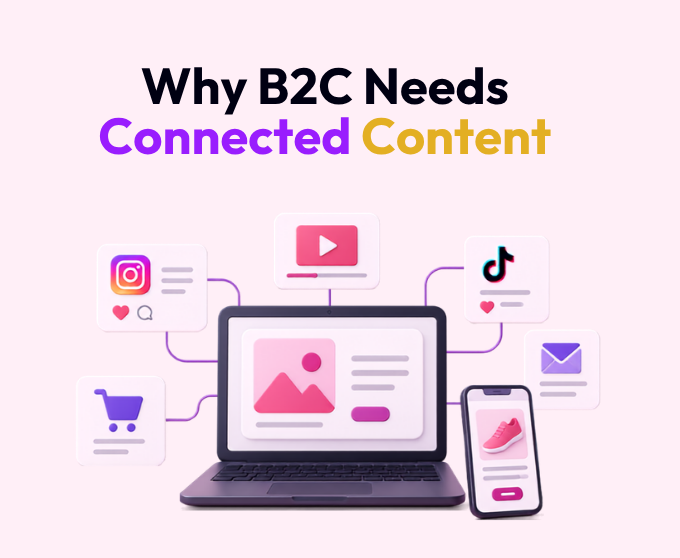
Quick answer: Connected content is a single message and data architecture that keeps every touchpoint, social, website, ads, customer support, and AI search answers, synced to the same facts, pricing, and tone, so a customer never receives conflicting information no matter where they meet the brand.
The Gap Nobody Talks About
Picture this, common across D2C brands: a customer buys a product at full price, then gets an email offering 20% off the same item an hour later because the CRM and the e-commerce platform never synced. Or the social media marketing team posts about a feature that the website hasn't updated in three months. These are not edge cases. They are the default state of most marketing organisations, where 72% of in-house marketers admit they have plenty of data but no clear read on what it means, and 65% of marketers say silos actively reduce campaign clarity.
Customers don't experience "departments." They experience one brand, and every contradiction they spot chips away at trust before a single purchase decision is made.
Content Marketing and Social Media Marketing Stopped Being Separate Jobs
For years, brands treated content marketing as the long-form, SEO-driven work, and social media marketing as the fast, reactive layer on top of it. That separation is now actively working against growth. A single piece of research, a founder interview, or a product update should function as one content atom that gets reshaped into a blog post, three social formats, a support macro, and an FAQ answer, all carrying identical facts. When these live in separate calendars run by separate people with separate approvals, the brand starts contradicting itself in public, which is exactly what the silo data above describes.
Take something as routine as a price change. If pricing lives only in the e-commerce backend, the social team keeps running an ad with the old number, the blog post comparing plans goes stale, and support agents quote a third figure entirely. One update, three versions of the truth, and a customer who now has a reason to doubt everything else the brand says.
The AI Search Shift That Changes the Rules
Here is the part most brands still haven't priced in. About 60% of searches now end without a single click to any website, and when Google shows an AI summary, people click through to a traditional result in only 8% of visits, versus 15% when no summary appears, per Peec AI's GEO statistics report. ChatGPT alone now serves close to 900 million people weekly. Customers now get answers about your brand from an AI system before they land on your site, and that system pulls whichever version of your content is most complete and consistent.
This is where most SEO instincts fail brands. Princeton's original GEO research found keyword stuffing performs worse than doing nothing, while adding real statistics, quotations, and citations lifted visibility in AI answers by up to 40%. More surprising: fifth-ranked websites gained over 115% visibility from citing sources, while first-ranked sites actually lost 30.3% visibility from the same tactic. AI search does not automatically reward the biggest budget. It rewards the clearest, most internally consistent source of facts, something a fragmented content operation cannot produce.
What Disconnection Actually Costs
The revenue math is not subtle. Brands with strong omnichannel engagement retain 89% of customers versus 33% for weaker ones, and companies running connected strategies see 9.5% annual revenue growth against 3.4% for siloed competitors, based on analysis from RevenueMemo. Shoppers who buy across both online and offline channels carry 30% higher lifetime value. On top of that, Gartner research puts the cost of bad, disconnected data at $12.9 million per company, per year. None of this shows up as a single failure. It shows up as slow, compounding erosion that finance notices before marketing does.
Building an Omnichannel Content Marketing Strategy That Actually Holds
A real omnichannel content marketing strategy starts with one source of truth for product facts, pricing, and positioning that feeds every channel automatically, not a shared folder everyone forgets to check. From there, brands need content built in modular atoms rather than campaigns, structured with clear headings and direct 40 to 60 word answers that both humans and AI engines can lift cleanly, as MarTech's analysis of connected marketing puts it: campaign-based execution is what created disconnected teams in the first place. Finally, someone has to own the audit: map every customer journey channel by channel to find where the story breaks. This does not need a new hire. It works best as a shared responsibility between whoever owns brand and whoever owns the tech stack, since the problem is rarely a lack of content, it is a lack of a single wiring diagram connecting it.
Conclusion
Connected content is no longer a nice-to-have layered on top of good marketing. It is the baseline. Brands that keep treating social media marketing, content marketing, and customer data as separate workstreams are not just inefficient, they are actively training customers, and now AI systems, to trust them less.
If your brand's channels are telling slightly different stories and you want them fixed before it shows up in your revenue numbers, talk to us. Reach Creative Nerds at +91 91670 08137 and let's build a content system that holds together everywhere your customers find you.